Overview
Elsevier's Pharma Solutions team sells specialty-audience advertising across Elsevier's medical journals, and elsmediakits.com is where that portfolio lives: a Drupal site that has to stay current with every journal, rate, and audience the team markets. Marketing for the site runs through next-mark, a marketing firm in Sarasota, Florida, that partners with Elsevier's marketing team.
The platform behind it had stalled. next-mark and Elsevier had been relying on a freelance developer who could not commit the time the site needed, and a year's worth of requests had built up with no date attached to any of them. Blue Drop Labs was brought in to take over maintenance of the platform. We cleared that backlog and gave the Elsevier team a site that moves again.
A year of work with nowhere to go
Nothing was broken in a way that made headlines. The site was up. But every improvement the marketing team wanted, from content structure changes to new journal listings to fixes that had been reported months earlier, sat in a queue behind a single person's availability. Requests were scheduled around a freelancer's calendar, then rescheduled, then quietly dropped.
For a marketing team, that is a campaign problem, not a technical one. Media kits go out on a schedule, and a site that cannot change on that schedule stops being an asset. next-mark needed a partner who would own the platform the way they own the marketing.
Taking over a Drupal site someone else built
Most of the Drupal work we do starts with a site we did not build. Taking one over well is a discipline of its own, and it is what we did for elsmediakits.com in the first weeks:
- Audit before anything else. We read the codebase, the module inventory, the content model, and the hosting setup, and wrote down what we found, so decisions were made on facts rather than on what the last developer remembered.
- Secure the foundations. Access, environments, backups, and a repeatable deployment path, so every change afterward could ship safely.
- Bring core and contributed modules current. Security updates first, then the upgrades that had been deferred because nobody had time to test them.
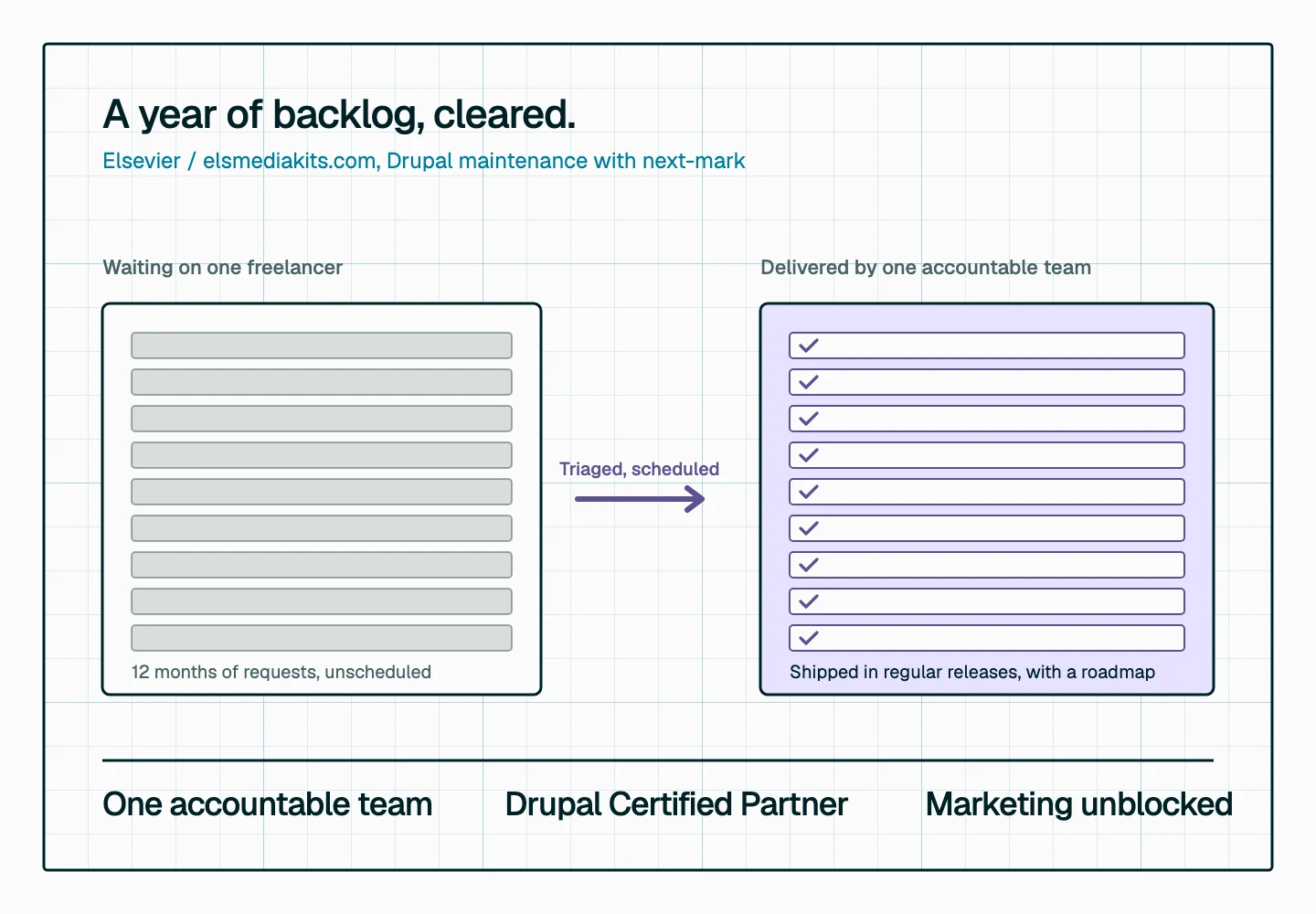
- Turn the backlog into a plan. We triaged a year of requests with next-mark and Elsevier, grouped them into releases, and put dates on them.
Clearing the backlog
With the foundations in place, the backlog became a release schedule instead of a wish list. We worked through it in regular, predictable releases, each one reviewed with next-mark before it went live, so the Elsevier team could plan campaigns around changes they knew were coming. Within the engagement's first stretch, a year of stalled requests had shipped.
Just as important is what happens now: new requests get an estimate and a date, security updates land on a cadence, and the marketing team no longer waits to find out whether the site can do what the campaign needs.
An agency partnership that works
next-mark owns the marketing relationship with Elsevier; Blue Drop owns the platform. That division is deliberate. The agency keeps a single point of contact for its client and a development partner it can plan around, and Elsevier gets a site maintained by a team that is accountable for it, without adding another vendor to manage.
We work this way with several marketing agencies: they bring the client relationship and the campaigns, we bring the Drupal engineering, hosting, and maintenance that keeps the site delivering.
Why we specialize in this
Blue Drop Labs is a Drupal Certified Partner, a Drupal Association program for organizations that contribute to the project and deliver it well, and the practice is led by a Triple Certified Drupal Expert. We build new Drupal platforms, but a large share of our work is taking over existing ones: sites built by a previous agency or a freelancer, running behind on updates, with a backlog nobody has been able to schedule.
That work rewards experience. Knowing which contributed modules are safe to upgrade, how to untangle a content model without breaking editors' workflows, and how to keep a site secure while its roadmap catches up is exactly what a certified team does every week. It is also why we offer managed Drupal hosting alongside maintenance: the same engineers who know the codebase keep it running.
Inherited a Drupal site with a backlog nobody can schedule?
Talk about taking it over